


Without clear and predictable rules, a key development tool risks becoming a source of instability.

© World Bank/Chhor Sokunthea | A garment factory in Phnom Penh, Cambodia.
Trade preferences – of which a notable example is the Generalized System of Preferences (GSP) – have long helped the world’s poorest countries expand exports and integrate into global markets. But their impact is becoming less predictable.
New UN Trade and Development analysis shows that tariff margins alone do not determine development outcomes. What matters is predictability – how trade preferences are reviewed, renewed and adjusted over time.
For more than five decades, special trade arrangements have helped the world’s poorest countries expand exports and integrate into global markets.
Because these schemes can be changed unilaterally by granting countries under domestic rules, shifts in market access may occur with limited coordination. Without clear timelines and communication, the impact is felt immediately by exporters, workers and investors.
Agreed in 1968 at UNCTAD’s second Conference, the Generalized System of Preferences allows developed economies to reduce or eliminate import tariffs on goods from developing countries without requiring reciprocal market opening.
These non-reciprocal trade preferences were designed to support industrialization, export diversification and job creation. Today, 42% of eligible exports from beneficiary economies – worth $165 billion – enter major markets under preferential tariffs. Around 25 economies grant such preferential access, and approximately 70% of least developed country (LDC) exports are destined for these markets.
For many LDCs, particularly those exporting garments and footwear that typically face high duties, this access supports factories, investment and livelihoods.
Sudden changes in market access are hitting exports, jobs and investment Recent experience illustrates how modifications to preference schemes can influence trade performance and investor confidence.
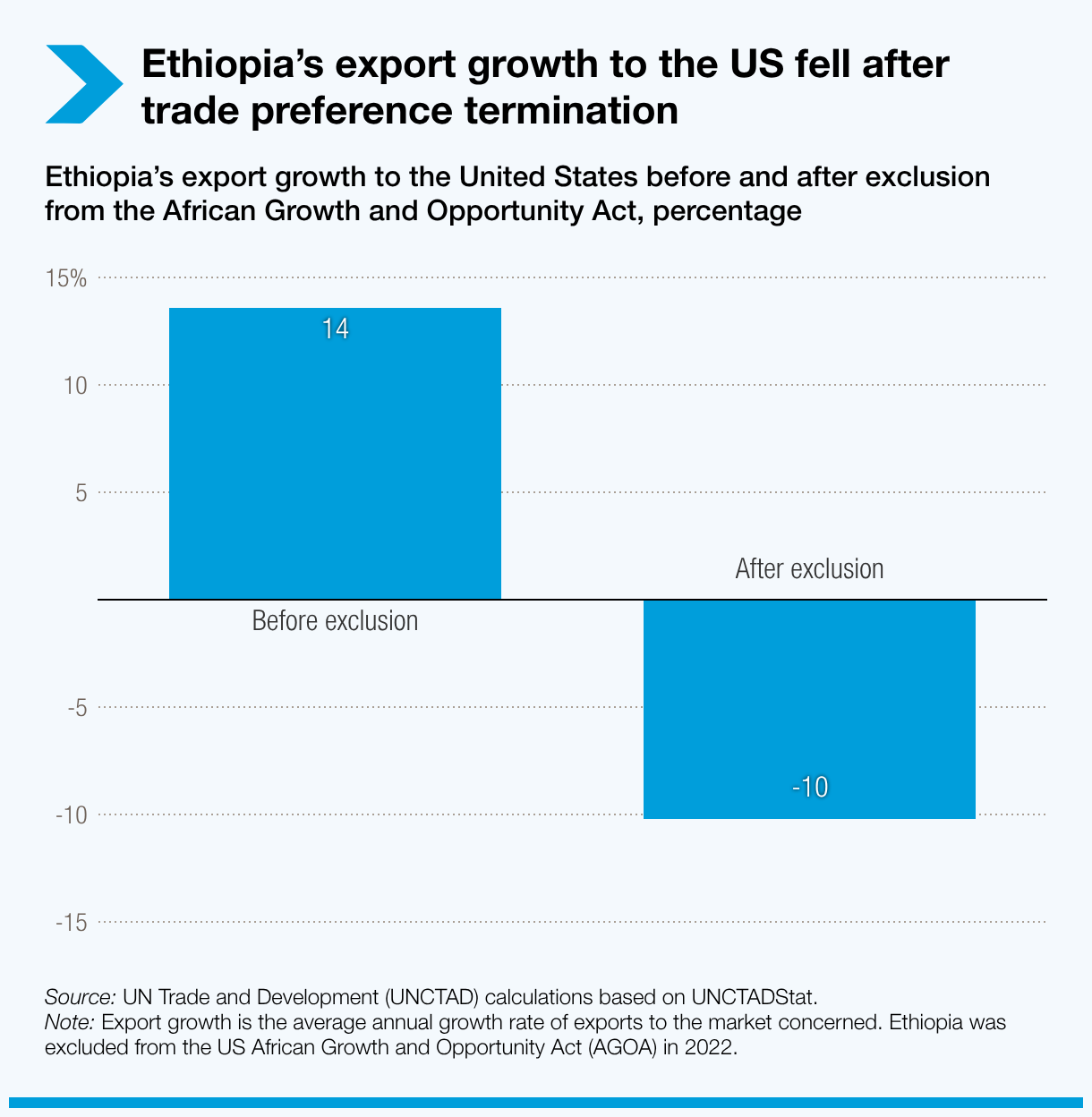
Following Ethiopia’s removal from the United States’ African Growth and Opportunity Act (AGOA) in 2022, export growth to the US shifted from an annual increase of 13.6% to a decline of 10.2%.
The adjustment period coincided with more than 1,000 layoffs, the departure of 18 foreign companies between 2022 and 2025 and a $1 billion reduction in foreign direct investment inflows in Ethiopia.
In Cambodia, the partial suspension of access to the European Union’s Everything-But-Arms scheme in 2020 was followed by a decline in the EU’s share of national exports from 28% to 17%, alongside factory closures and work suspensions affecting approximately 150,000 workers.
These experiences show that without transparency, advance notice and phased implementation, trade preferences can quickly turn from support into shock. Clear transition pathways can help firms, workers and investors adjust more smoothly.
Uncertainty is becoming the biggest risk
Predictability also depends on the timely renewal of trade preference programmes.
When the United States’ Generalized System of Preferences expired in 2020, imports from eligible countries without alternative preferential arrangements declined by 10.5%.
Countries able to rely on overlapping schemes such as AGOA were better positioned to cushion the impact, underscoring the value of coordinated and well-sequenced frameworks that maintain continuity and limit disruption.
Without smooth transitions, progress can reverse
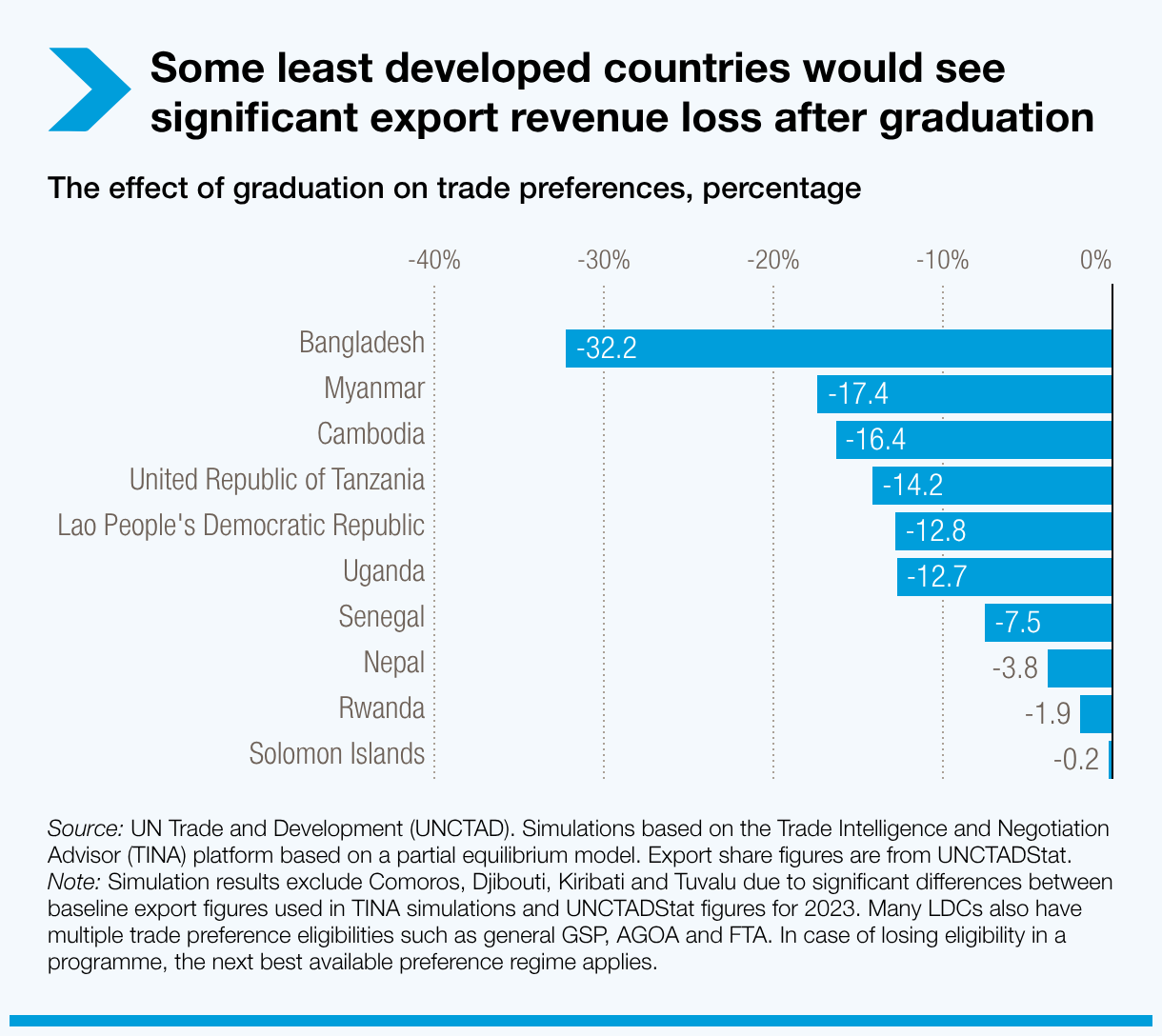
Graduation from LDC status marks economic progress but may also involve changes in preferential treatment.
UN Trade and Development research indicates that the loss of trade preferences upon graduation could reduce total exports by 32% for Bangladesh, 17% for Myanmar and 16% for Cambodia.
Extended phase-out periods and pathways into alternative schemes can help ensure that graduation strengthens integration rather than creating avoidable shocks. Several partners have introduced post-graduation transition arrangements, reflecting a shared commitment to sustaining development gains.
Through policy analysis, technical assistance, and intergovernmental policy dialogue, UN Trade and Development supports efforts to modernize trade preference regimes.
In today’s fragmented trading system, the issue is no longer just market access, but whether countries can rely on it. Without predictability, trade preferences risk shifting from a tool for development to a source of instability.