

Cooperation among developing economies has surged over recent decades, but much of it remains invisible in data, not captured by traditional development metrics.

© Shutterstock/Joa Souza | a worker harvests coffee in the city of Itabela, Brazil.
Trade and investment flows among developing economies have surged over the past three decades. Today, countries of the global South account for a rising share of world trade, output and foreign direct investment.
These gains are linked to South-South cooperation, which has expanded in scale and ambition. But one core problem persists: much of it remains invisible in data.
Capturing how cooperation between developing countries translates into financial support, as well as technical and in-kind assistance, is key to understanding its contribution to sustainable development.
Traditional development metrics were built to track North-South flows. They were not designed to capture the complexity of financial and non-financial support among developing economies.
This is the gap UN Trade and Development (UNCTAD) is working with countries to close through its project Quantifying South–South cooperation for the Sustainable Development Goals (SDGs).
The first data submitted by nine pilot countries reveal significant levels of South-South cooperation.
This work responds to calls from leaders at the UNCTAD16 South–South Cooperation Forum to strengthen country-owned data for priority setting, strategic partnerships and shared prosperity.
Capturing the full spectrum of cooperation, beyond financial ledgers
This initiative builds on a voluntary Conceptual Framework for the Statistical Measurement of South–South Cooperation – developed by the global South, for the global South, with support from across the UN system.
The framework provides a common method for developing countries to measure and report government-led activities aimed at sustainable development or humanitarian purposes and that are concessional in nature. It defines what counts as South–South cooperation, classifies different types and helps countries collect comparable data across three main modalities – beyond what shows up in financial ledgers:
- Financial modalities – grants, loans, credit lines, budget support
- Non-financial modalities that are monetized – technical assistance or services valued in monetary terms
- Non-financial modalities measured in non-monetary units – training sessions, expert deployments, scholarships, equipment transfers, policy exchanges
Most South-South cooperation remained in the region
The first data submitted by nine pilot countries in Latin America and the Caribbean to SDG indicator 17.3.1 – which tracks additional financial resources mobilized for developing countries – reveals significant levels of South-South cooperation.
Brazil reported the largest single-year amount of monetized support, with $159 million in 2022. Mexico followed, with $43 million disbursed in the same year.
On average, 85% of monetized support remained within the region, with Venezuela and Argentina as the top recipients.
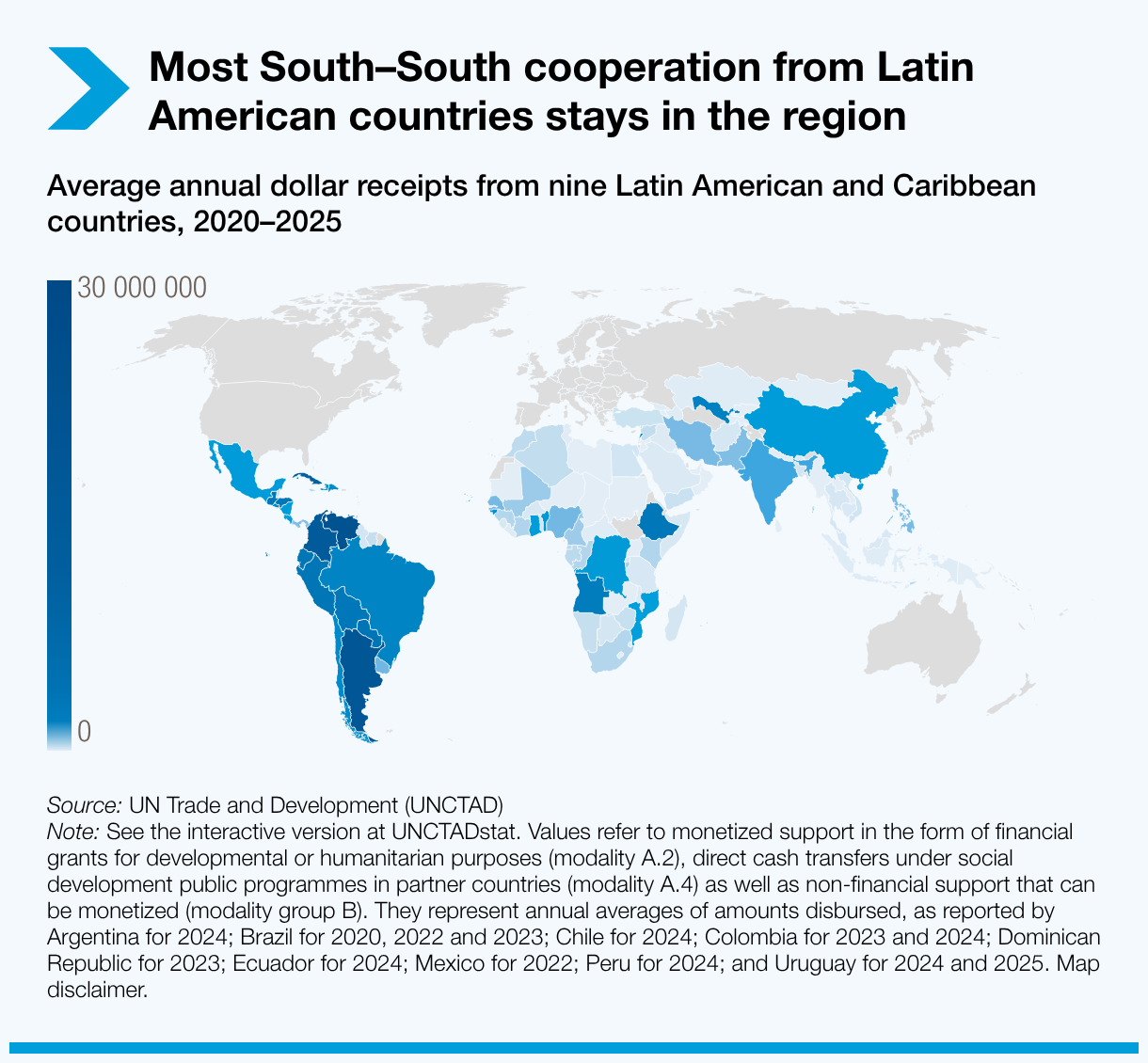
African countries received 10% of the total support, while developing economies in Asia and Oceania got 5%.
Most of the support went to other developing countries, with least developed countries accounting for only 8%.
Most South-South cooperation is non-financial
South-South cooperation goes beyond financial support, such as grants for developmental or humanitarian purposes, direct cash transfers under social programmes, and non-financial support that can be monetized.
It also takes the form of non-monetized support that cannot be valued in monetary terms.
Almost all South-South cooperation activities (99%) reported by the nine pilot countries in Latin America and the Caribbean are non-financial.
Around one in seven (14%) are non-monetized, delivered in the form of goods and materials, food or medicine, and experts or specialists deployed in technical cooperation projects.
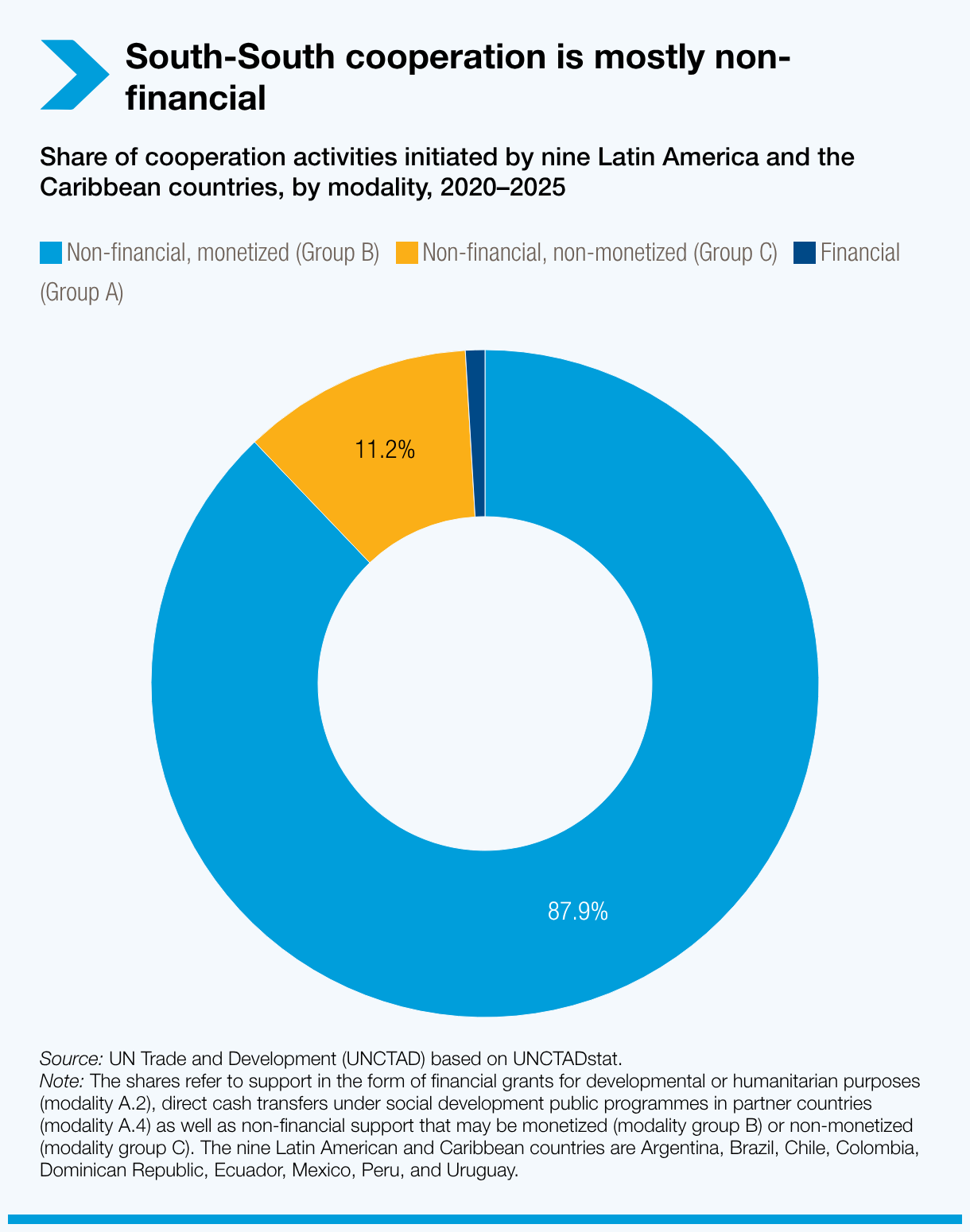
Argentina and Uruguay, for instance, are reporting only non-monetized South-South cooperation flows. This highlights the important role of in-kind support between developing economies.
Scholarships top South-South cooperation instruments
Scholarships are the primary cooperation instrument reported by the nine countries from Latin America and the Caribbean. On average, they organized 1,433 scholarship-related activities each year.
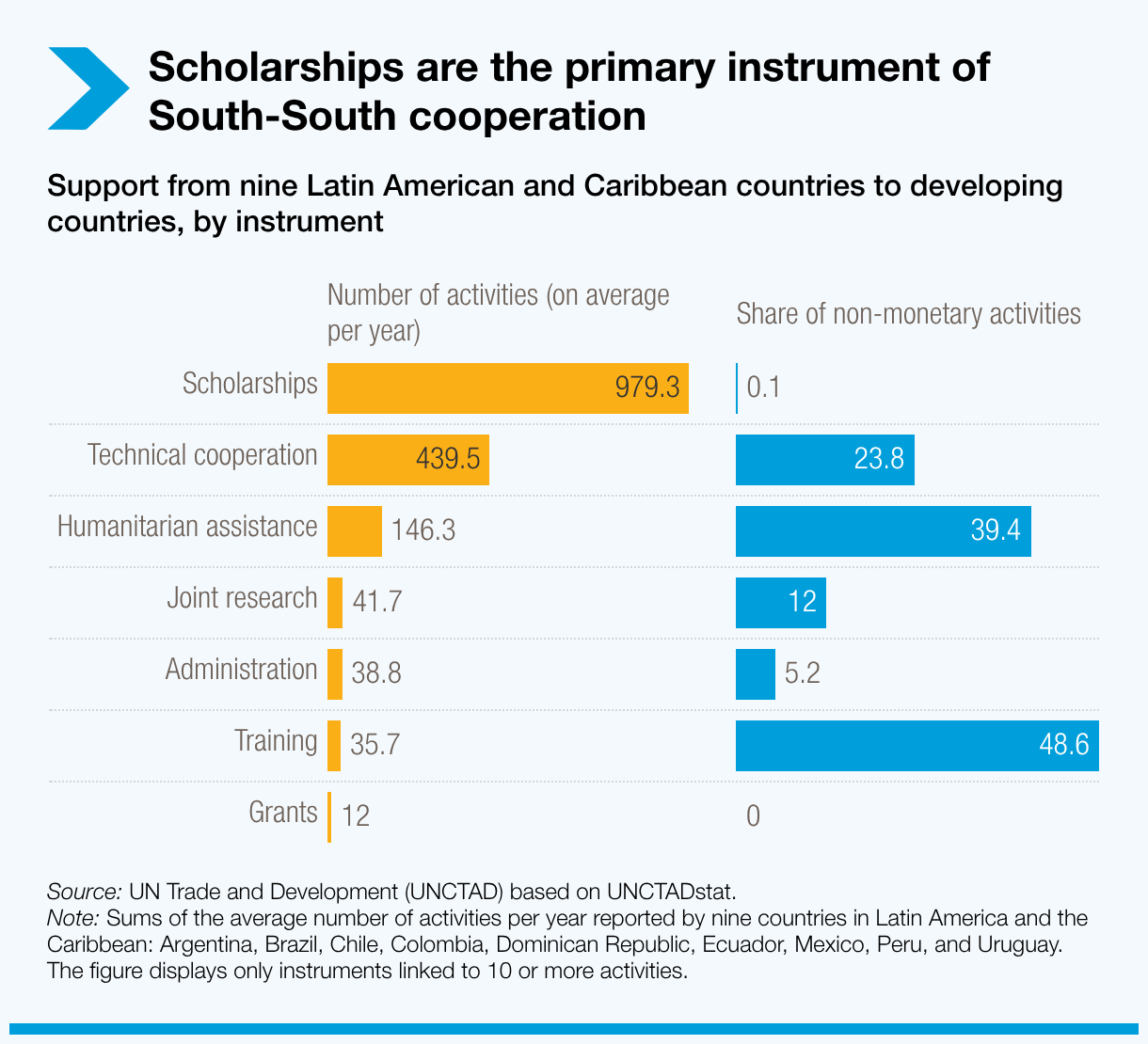
While scholarships were almost entirely provided in monetary terms, other common non-monetary cooperation instruments included training and humanitarian assistance.
Unlocking shared prosperity through data
Through its global project on quantifying South-South cooperation, UNCTAD is helping countries close a systemic data gap that is critical for sustainable development.
This effort calls for stronger national statistical systems, the integration of South–South cooperation data into sustainable development strategies, deeper partnerships among developing economies and sustained financing and support for development.
Measuring cooperation is not just about counting transactions. It’s about enabling countries of the global South to design their own pathways to sustainable, inclusive and resilient development, together.